
Tuvalu is on the frontlines of the climate crisis.
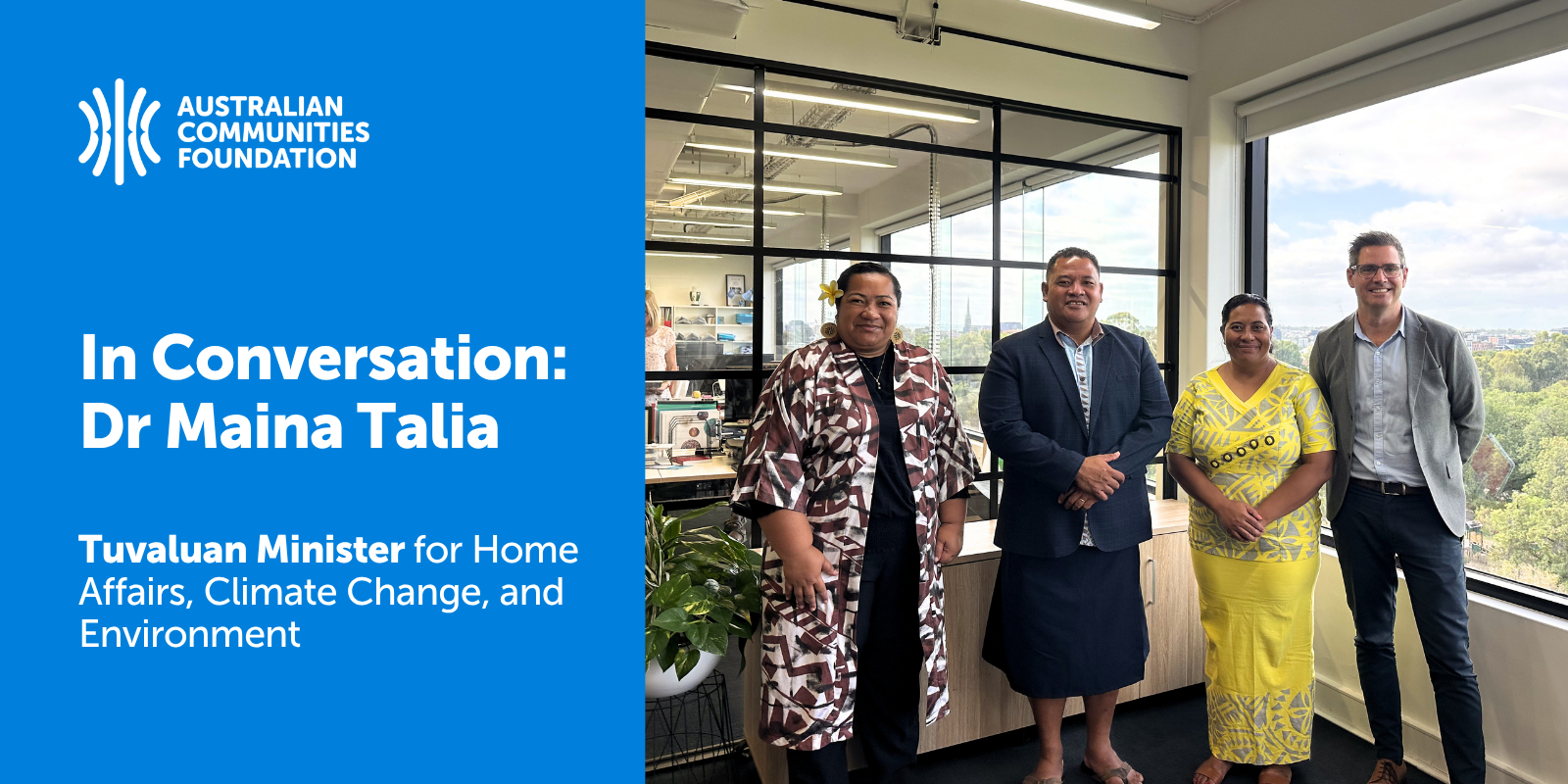
On a recent visit to Australia, Tuvaluan Minister Dr Maina Talia spoke with Australian Communities Foundation CEO Andrew Binns about the challenges facing the Pacific and the role philanthropy can play in supporting communities to lead solutions.
Watch Video
Australian Communities Foundation CEO, Andrew Binns, in conversation with Dr Maina Talia, the Tuvaluan Minister for Home Affairs, Climate Change, and Environment.
Video Transcript
Andrew Binns: I’m excited to be joined by Tuvaluan politician and climate change activist, the Honourable Dr Maina Talia. Welcome to Australian Communities Foundation.
Mania Talia: Thank you. It is an honour to be here.
AB: You serve as the Minister for Home Affairs, Climate Change and Environment in Tuvalu, which has long been on the front lines of and a clear voice around climate change for the Pacific more broadly. Can we start by just understanding what prompted your visit to Australia?
MT: Thank you, Andrew. It is indeed an honour to visit your foundation this morning and to learn how the foundation can be of support to the Pacific countries, especially a country like mine, which is literally facing the brunt of climate change.
I have been working closely with the not-for-profit organisation, Climates [who support community-led climate resilience across the Australia-Pacific], and they have been part of the work that we do in Tuvalu, Kioa and other parts of the Pacific, especially with their small grants that support communities in the Pacific. I was invited here to be part of their 10th anniversary celebrations.
AB: Can you share a bit about what it’s like to live in Tuvalu and how climate change is directly impacting daily life there?
MT: We are facing multiple issues related to climate change and sea level rise, but the major challenge we are facing is the fact that we have limited resources to respond.
When the community that lives on the coastal lines of Tuvalu is being asked to move further inland, the question we face is: Where do these people move? It’s just a small piece of land, a strip of land, and it’s difficult for them to comprehend where they should move – intruding on other people’s privacy is another challenge we are facing in Tuvalu.
So we are facing multiple challenges on the island, especially when it comes to high tide and being hit by tropical cyclones and drought. Water is always an issue. Food security is another issue for us. We have to import, so the question is not about the choices and the varieties of food, but what is available on the shelf for our people. We are not able to choose based on quality. We are only able to choose based on availability of food on the market.
We’re not telling the world that we are giving up… We’re telling the world that we will continue to exist.
But we can do a lot of things in Tuvalu when it comes to food security and water security. We just need resources coming directly to the communities in order for them to build their water reserves and to enter into organic farming. There are things that can be done.
We’re not telling the world that we are giving up and we are not throwing in the towel. We’re telling the world that we still want to exist. We’re telling the world that we will continue to exist. That’s why we have been putting out this moral call for neighbouring countries that have the ability to support us.
AB: And are countries listening? One of the things you mentioned is that there are things the Tuvaluan community can do. How do we help centre Tuvualuan culture and leadership? What should we be doing at our end to help with that?
MT: Over the past many years, the way funds are being operated in the country – you need to do tick all these checkboxes in order to receive the funds. But I think we should change the whole funding narrative. It’s a matter of relationship. It’s a matter of solidarity, and solidarity has no colour. Solidarity has no border. Solidarity is about community and people, and the relationship with the people who bring the funding to the community.
One way we’re approaching resourcing is called kato funding. Kato is the Fijian word for basket, and we use this approach to ensure that whatever money we have in the Pacific, we can all put into that basket and to see who needs it the most, and we will give it to that community with the understanding that their report can only be done on a small video. We don’t want to hassle them to write all these lengthy reports as if they have received billions of dollars. It’s only a small grant of $20,000 to $50,000 that is needed for them after a cyclone, for example. Through this, they receive the support to get on their feet before government comes and does the proper evaluation.
It’s about realising that people exist in other parts of the world who are struggling to survive, struggling to ensure life continuity on their island is possible.
I must acknowledge the support from not just the government of Australia, but the people themselves who are willing to support Tuvalu in many ways. It’s not just funding. It’s not just money that we are going after.
It’s about realising that people exist in other parts of the world who are struggling to survive, struggling to ensure life continuity on their island is possible. So for all the support that has been rendered, not just to Tuvalu, but to the Pacific communities – thank you so very much.
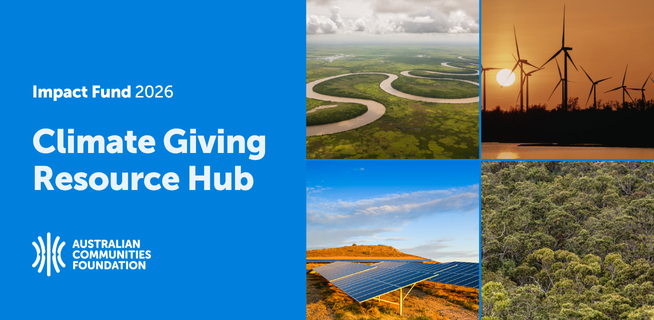
The climate crisis is the focus of Australian Communities Foundation’s Impact Fund program for 2026. The Impact Fund is our flagship collective giving initiative, and you can learn more about ways to get involved by exploring our Climate Giving Resource Hub.